
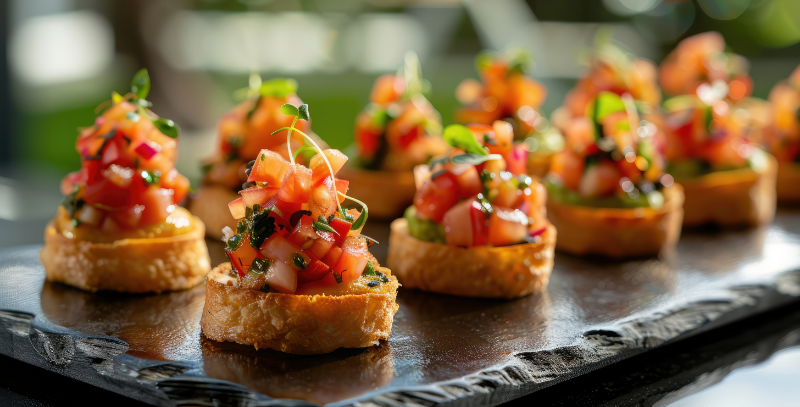
You’ve asked a caterer to quote “finger food” for your reception and received a breakdown listing “canapés per piece.” If you expected a per-pax buffet price, the shift to piece-count pricing can feel opaque. Canapés aren’t random snacks—they’re structured single-bite appetizers priced by the bite, not the guest, and understanding the planning logic (how many pieces, hot or cold, halal-verified or not) makes budgeting and ordering straightforward.
Canapé Catering at a Glance
Field | Detail |
What it is | Base + topping, one bite, one hand |
Why it matters | Guests mingle standing; no cutlery needed |
Governing body | MUIS (halal certification only) |
How to verify | Check MUIS halal directory before booking |
Planning unit | Pieces per guest (not weight per pax) |
Typical count | 6-8 pre-dinner; 10-14 meal replacement |
Price logic | Per piece, not per pax by weight |
 What Canapé Catering in Singapore Actually Means
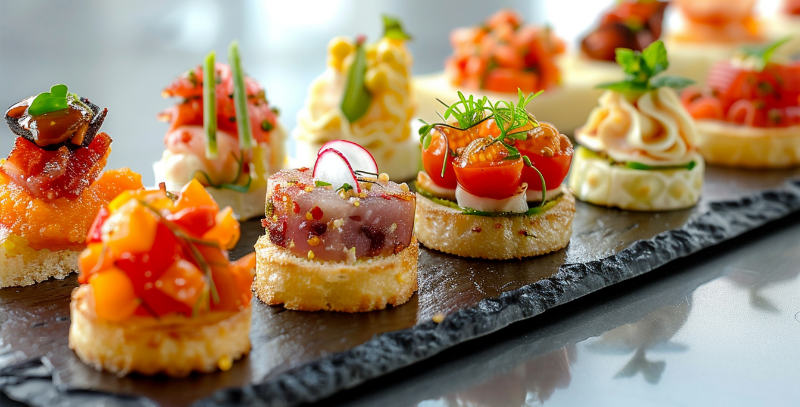
A canapé is a small prepared appetizer consisting of a base—bread, toast, cracker, or pastry—topped with a savoury spread or garnish, held in the fingers and eaten in one bite. The term derives from the French word for sofa, drawing an analogy between the garnish sitting atop the bread as people sit on a sofa. Canapés are a type of hors d’oeuvre designed for a specific social function: they allow guests to eat while mingling at standing receptions, holding a glass in one hand and a bite in the other. Because they often accompany cocktails, many canapés are salty or spicy to encourage drinking.
Unlike the broader “finger food” category—which includes anything eaten without utensils, from samosas to chicken wings—canapés are defined by their architecture: one self-contained, bite-sized morsel that delivers a complete flavour in two chews, without requiring cutlery or a seated position. They also differ from tapas — small Spanish sharing plates eaten with cutlery or from a communal dish, rather than as a single bite.
 How Canapés Work
Structure and Rules
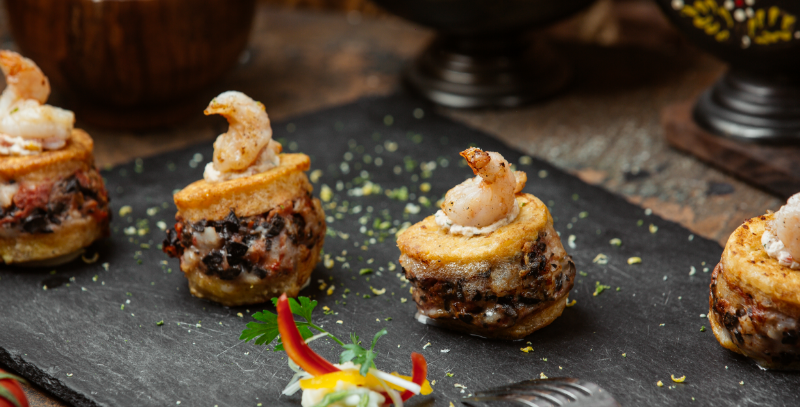
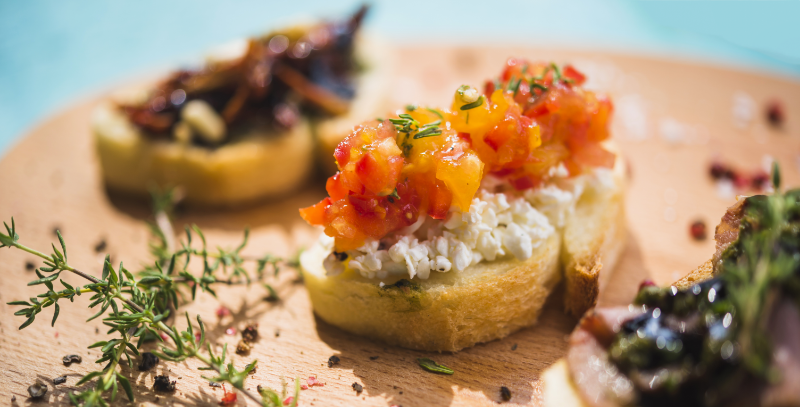
A canapé always consists of a base and a topping; it may also include a sauce or spread and a garnish. The base must be sturdy enough to be picked up with fingers without bending, breaking, or immediately becoming soggy. Common bases include:
- Toasted baguette slices
- Crackers
- Puff pastry
- Blinis
- Cucumber rounds (gluten-free)
- Endive leaves (gluten-free)
The base should be roughly the size of a half-dollar coin or small square, between 1 to 1.5 inches in diameter. Height should sit under one inch from base to garnish—higher than that, the topping falls off on the lift.
Categories
Canapés divide by temperature and flavour:
- Hot vs. cold: Hot canapés (mini-quiche, arancini) require immediate service and warming equipment. Cold canapés (smoked salmon on toast, vegetable tartare) can be displayed for up to two hours at room temperature.
- Savoury vs. sweet: Savoury canapés dominate event menus. Sweet canapés (fruit tartlets, petit fours) typically appear in a 4:1 ratio to savoury.
 Menu Variety
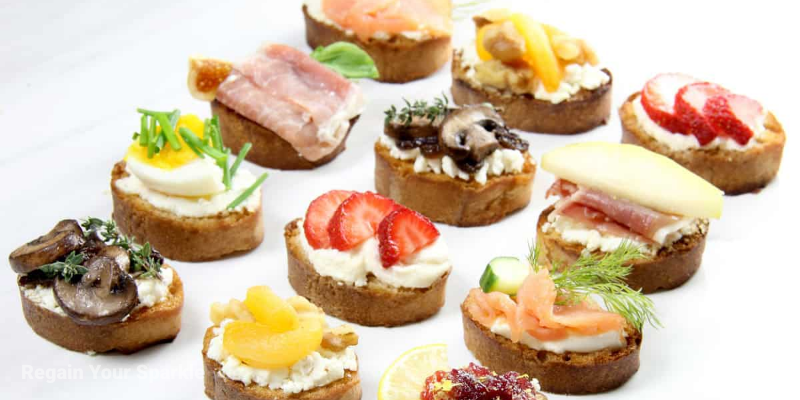
A balanced canapé selection covers protein, vegetarian, and dietary needs. Typical options include:
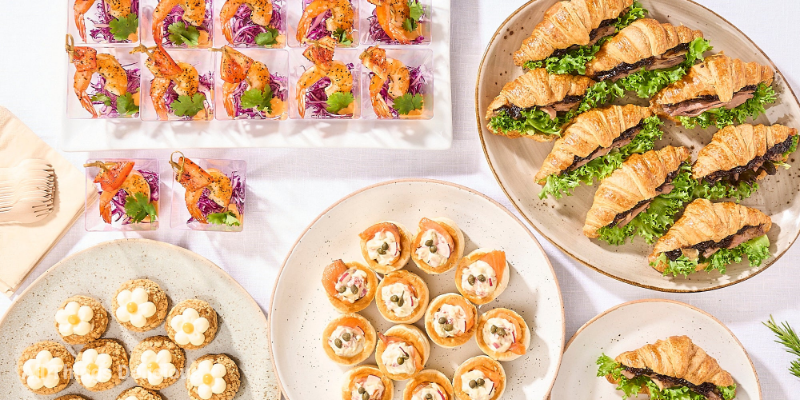
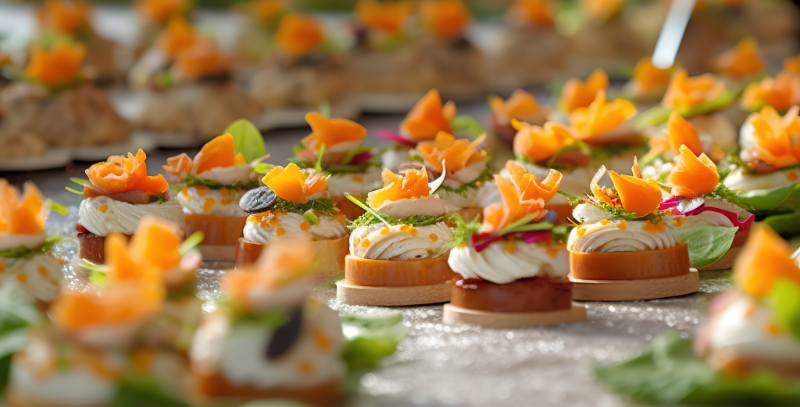
- Protein: Smoked salmon, chicken skewers, beef tartare, prawn cocktail
- Vegetarian: Hummus and cucumber, mushroom quiche, vegetable tartare, falafel bites
- Dietary-specific: Rice crackers or polenta rounds (gluten-free), vegetable bases (vegan, gluten-free), dairy-free spreads (vegan)
Event planners typically recommend a mix of hot and cold items across meat, fish, and vegetarian categories.
Quantity Planning
Canapé service is planned by pieces per guest, not by weight. The count depends on event duration and whether canapés replace a meal or precede one:
- Pre-dinner reception (45 min – 1 hour): 6-8 pieces per guest
- Standalone cocktail reception (1.5-2 hours): 10-12 pieces per guest
- Meal replacement (2+ hours): 10-14 pieces per guest, including more substantial items
- Post-ceremony drinks (wedding with banquet to follow): 3-4 pieces per guest
- Private party at home (4 hours, no other food): 8 savoury + 2 sweet per guest
Because canapés are priced per piece rather than per pax by weight (like buffets), budgeting requires multiplying pieces-per-guest × guest count × price-per-piece, then adding delivery, setup, and service fees. A caterer quoting “S$24/pax for 6 pieces” translates to S$4/piece; a box of 16 pieces at S$120 works out to S$7.50/piece.
Service Styles
Butler-passed service involves wait staff circulating with trays, offering canapés directly to guests. This adds elegance and ensures even distribution, but requires service staff (typically one server per 20-30 guests for a 1.5-hour reception) and costs more.
Stationary service places canapés on buffet tables or scattered stations where guests self-select. This lowers cost (no service staff required) and lets guests see all options, but popular items may run out early and queuing can occur.
Many hosts use both: stationary displays for volume, butler-passed service for premium items.
 Halal Canapé Requirements
Halal canapés in Singapore require two elements:
- Halal-verified ingredients: All raw materials, processing aids, and additives must be halal, substantiated with supporting documents.
- MUIS-certified kitchen: Preparation in a facility certified under MUIS’s Food Preparation Area (FPA) scheme (for caterers and central kitchens) or Eating Establishment (EE) scheme (for restaurants and stalls).
MUIS certification verifies that the kitchen maintains clearly defined production lines, storage areas, crockery, utensils, and dishwashing facilities for halal products, and that any utensils previously in contact with pork or dog meat have undergone ritual cleansing.
Why “no pork, no lard” signage is not certification: Some caterers display “no pork, no lard” without holding MUIS certification. This addresses only visible meat ingredients—it does not cover hidden animal-derived additives (gelatine, emulsifiers, enzymes), cross-contamination from shared equipment, alcohol-based flavourings, or kitchen separation protocols. Only MUIS certification verifies comprehensive halal compliance.
To verify before booking, check the caterer’s MUIS certificate number directly on the MUIS halal directory. A logo on a website is not sufficient proof. Learn how to check a halal certificate in Singapore and understand what the certification covers.
 Who Governs It
MUIS (Majlis Ugama Islam Singapura), Singapore’s Islamic Religious Council, is the sole authority for halal certification in the country. MUIS administers two schemes relevant to canapé catering: the Eating Establishment (EE) scheme for restaurants and food stalls, and the Food Preparation Area (FPA) scheme for catering establishments and central kitchens. Certification requires at least two full-time Muslim staff per outlet (at least one holding MUIS Halal Team Member certification) and compliance with MUIS’s Halal Quality Management System principles.
For the full breakdown of halal food standards and certification in Singapore—including scheme requirements, ingredient traceability, validity periods, and how MUIS certification compares to JAKIM (Malaysia) and BPJPH (Indonesia)—consult the governance hub.
 The Practical Angle
Food Safety and Timing
Cold canapés can be displayed for up to two hours at typical room temperature before requiring refrigeration; if the temperature exceeds 32°C, cut that time to one hour. Hot canapés should be served immediately and held above 60°C in warming equipment.
Cross-Contamination at Mixed Events
At events serving both halal and non-halal canapés, risks include shared platters, utensils, or garnish bowls. Hosts planning halal canapés should confirm with the caterer that halal and non-halal items are prepared, stored, plated, and served separately.
Dietary Labelling
Guests cannot visually identify allergens (nuts, gluten, shellfish, dairy) or dietary compliance (halal, vegetarian, vegan) in a finished canapé. Clear signage or individual labels at stationary displays, plus trained staff for butler-passed service, prevent inadvertent consumption.
Where Canapés Fit
Canapés suit any standing reception where guests hold a glass and circulate:
- Cocktail receptions: Pre-dinner networking at corporate launches, gallery openings, charity galas
- Weddings: Pre-ceremony tea reception, cocktail hour between ceremony and banquet, or evening “cake and punch” receptions replacing a full meal
- Office events: Product launches, client receptions, festive office parties
- Private gatherings: Birthday parties, engagement celebrations, home entertaining
Singapore event planners typically book canapé catering with 7-14 days’ lead time; during peak festive periods (Hari Raya, Chinese New Year, December), book 3-4 weeks ahead. Large events (200+ guests) or bespoke menus may require 4-6 weeks for menu design, tasting, and confirmation.
 How to Choose
When choosing canapé catering in Singapore, verify:
- Dietary compliance: For halal canapés, confirm the caterer holds current MUIS certification (FPA or EE scheme) and verify the certificate on the MUIS halal directory before signing a contract.
- Menu variety: Confirm the caterer offers hot and cold options, and can accommodate vegetarian, gluten-free, and other dietary needs.
- Quantity guidance: Ask the caterer to recommend piece-per-guest counts based on event duration and whether canapés are the sole food or precede a meal.
- Service style: Clarify whether the quote includes butler-passed service (requires staff) or delivery only (stationary display, no service staff).
- Pricing transparency: Confirm whether the per-pax or per-piece quote includes delivery, setup, service staff, and equipment (warming trays, platters); ask about GST (9%) and any festive-period surcharges.
Key Takeaways
- Canapé = base + topping, one bite, eaten with one hand
- Plan by pieces-per-guest (6-8 pre-dinner, 10-14 meal replacement), priced per piece
- Halal = verified ingredients + MUIS-certified kitchen—check directory before booking
- Cold canapés suit self-service; hot canapés need timed butler service or warming equipment
- Book early for peak festive periods (Hari Raya, CNY, December)
Where Intercontinental Catering Fits
Intercontinental Catering provides MUIS-certified halal canapé selections for receptions, launches, weddings, and events across Singapore, with delivery daily including public holidays. Our menu covers hot and cold options, savoury and sweet, and vegetarian, gluten-free, and dietary-specific selections. We can guide you on piece-per-guest planning based on your event duration and format, and offer both butler-passed service and stationary display setups.
Disclosure: Intercontinental Catering is a MUIS-certified halal caterer (cert no. FPGX21070001570, MUIS-certified since 2000). Verify current certification status on the MUIS halal directory before booking.
Contact: Call 6242 1191, email sales@incntl.com.sg, or visit us at 171 Kampong Ampat #05-18 KA Food Link, Singapore 368330.