
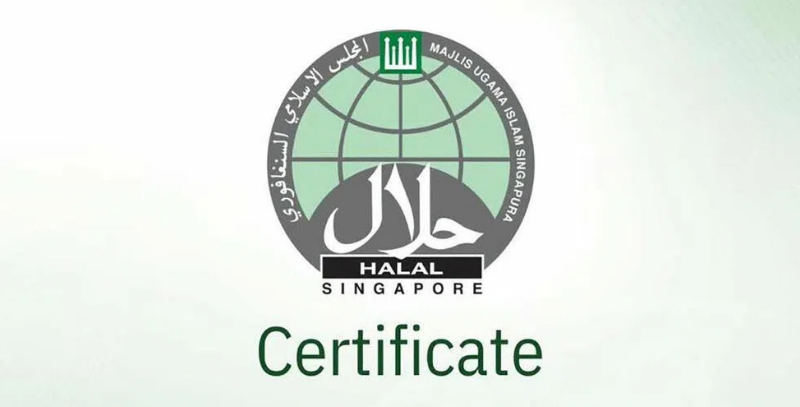
 You’re planning Hari Raya office catering or choosing a hawker stall for lunch, and you need to verify halal status—not just trust a wall poster or a delivery app tag. Under the Administration of Muslim Law Act, MUIS is Singapore’s sole legal certifier, and Muslim ownership alone carries no audit trail.
Topic-at-a-Glance
Field | Detail |
|---|---|
Plain definition | Verifying a valid MUIS cert matches outlet/product on halal.muis.gov.sg |
Why it matters | Legal compliance; assurance for 15.6% Muslim population |
Governing body | MUIS (Majlis Ugama Islam Singapura) |
How to verify | Search name + address on MUIS e-Service portal |
Validity period | 1-year typical; renewal starts 120 days prior |
Key rule | One cert = one address; chain branches certified separately |
Offence penalty | Fake halal claim: S$10,000 fine + 12 months jail |
Digital rollout | QR-enabled certs from 1 Oct 2025; scan for live status |

What Checking a Halal Certificate in Singapore Actually Means
Checking a halal certificate in Singapore means verifying that a food outlet, caterer, product, or stall holds a valid MUIS halal certificate and that the certificate matches the registered business name, address, and validity dates shown on the official MUIS e-Service halal directory (halal.muis.gov.sg).
Under Section 88A(1) of the Administration of Muslim Law Act (AMLA), MUIS is vested with sole legal powers to issue halal certificates in Singapore. Displaying an unauthorized halal sign is an offence carrying a fine up to S$10,000 and imprisonment up to 12 months.
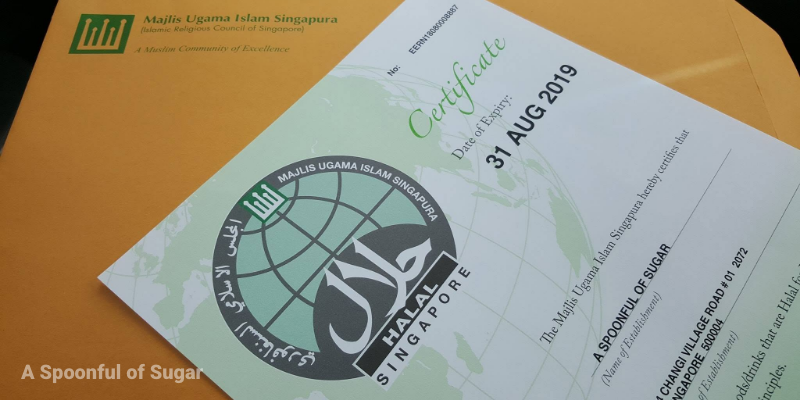
Why it matters: Singapore’s Muslim community—approximately 15.6% of the population per the 2020 census—relies on halal certification to meet Islamic dietary obligations (taqwa, God-consciousness in consumption). For hosts planning Hari Raya office events, school catering contracts, or family celebrations, proper verification guards against non-compliance, social embarrassment, and legal risk. MUIS halal requirements mandate that any certified eating establishment display its valid, original halal certificate prominently at the certified location, with the name on the certificate matching the foodstall or company name.
(For the religious and ethical underpinnings of halal food—prohibited categories, slaughter methods, and the Islamic law framework—see our companion guide Halal Food Standards & Certification in Singapore. This page focuses on the practical verification steps.)
How It Works
The Seven MUIS Certification Schemes
MUIS issues halal certificates under seven distinct schemes, each tailored to a facility type:
- Eating Establishment Scheme (Category 1 & 2) — Restaurants, cafés, hawker stalls (Category 1 for full-service; Category 2 for limited-menu operations)
- Endorsement Scheme — Imported, exported, or re-exported products requiring halal attestation
- Food Preparation Area Scheme — Central kitchens, catering operations, commissary facilities
- Poultry Abattoir Scheme — Facilities for freshly slaughtered poultry
- Product / Whole Plant Scheme — Manufacturing facilities producing packaged halal goods
- Storage Facility Scheme — Warehouses (stationary and mobile) handling halal products
- Short-term stall sub-schemes — Temporary operations such as Ramadan bazaar stalls (validity 1–3 months)
Each scheme has specific requirements; for example, Eating Establishment applicants must employ a minimum of two to three Muslim staff and comply with the 10 principles of the Singapore MUIS Halal Quality Management System.
What Makes Food Halal (Core Requirements)
MUIS halal standards prohibit specific categories and mandate controls to prevent cross-contamination:
Prohibited items:
- Pork and its derivatives — All parts, including lard and gelatin from pigs
- Non-halal slaughtered animals — Beef, lamb, chicken, duck not slaughtered according to Islamic rites (dhabihah: animal alive, throat cut to sever carotid arteries and jugular veins, Bismillah recited)
- Carnivorous animals — Dogs, cats, birds of prey
- Blood — Including residual blood not drained during slaughter
- Alcohol (khamr) as an intoxicant; trace levels from processing may be permissible under certain interpretations, but MUIS standards specify limits per scheme
- Hidden animal derivatives — Gelatin (from pigs or non-halal cattle), emulsifiers (E471/E472 if from animal fat), enzymes, flavourings from non-halal sources
Slaughter method (dhabihah): The animal must be alive before slaughter; Islamic slaughtering is necessary for all life halal animals except marine and non-mammal land animals. Singapore’s standard allows mechanical slaughter for poultry if the machine operator recites the invocation before running the machine.
Cross-contamination prevention: Equipment and utensils used for halal-approved food must not contact pork or its derivatives. If such contact occurs, it must be declared and subjected to ritual cleansing by MUIS.
Certification Is Per-Outlet
One MUIS certificate covers one physical address. A chain restaurant with five branches requires five separate certificates—one branch certified does not mean another is. The certificate validity period is typically one year; renewal applications start 120 days prior to expiry.
Transferability rule: Halal certificates are not transferable. If the certificate holder moves the business location, the existing certificate is automatically cancelled and invalid. The registered name and unit number on the certificate must match the physical storefront or kitchen you are verifying.
The Digital Certificate Rollout (October 2025)
From 1 October 2025, MUIS introduced digital halal certificates with QR codes. Members of the public can scan the QR code at certified shops to instantly check if the certification is valid. Establishments already certified by MUIS can continue displaying existing physical certificates until 31 March 2026; any business seeking recertification after 1 October 2025 receives only the QR-enabled version.
Who Governs It + Certification
Under Section 88A(1) of the Administration of Muslim Law Act, MUIS (Majlis Ugama Islam Singapura) is the sole statutory authority to issue halal certificates in Singapore. Any person who issues a halal certificate or uses a halal certification mark without MUIS approval commits an offence and is liable on conviction to a fine not exceeding S$10,000 or imprisonment up to 12 months, or both.
Foreign Halal Certification Bodies (FHCB)
As MUIS does not certify food products manufactured overseas, the responsibility lies with Foreign Halal Certification Bodies (FHCBs) it recognizes. To date, 101 FHCBs are recognized by MUIS under an enhanced recognition framework launched 1 October 2025.
Key regional bodies (non-exhaustive):
Body | Country | Key Distinction
|
|---|---|---|
JAKIM | Malaysia | Widely recognized gold standard; MUIS-recognized but ≠ SG cert |
BPJPH / MUI | Indonesia | Indonesian domestic cert; separate MUIS recognition required |
CICOT | Thailand | Thai Halal Board; must appear on MUIS FHCB list for SG validity |
IFANCA | USA | International cert body; recognized by MUIS for specific categories |
Critical distinction for consumers: A packaged product from Malaysia bearing a JAKIM logo is not automatically MUIS-certified for Singapore. You must verify that JAKIM (or the relevant FHCB) appears on the MUIS-recognized FHCB list for that product category. A MUIS certificate is for Singapore operations only; an unrecognized foreign certificate has no verified halal status in Singapore.
The Practical Angle

Risks + Red Flags
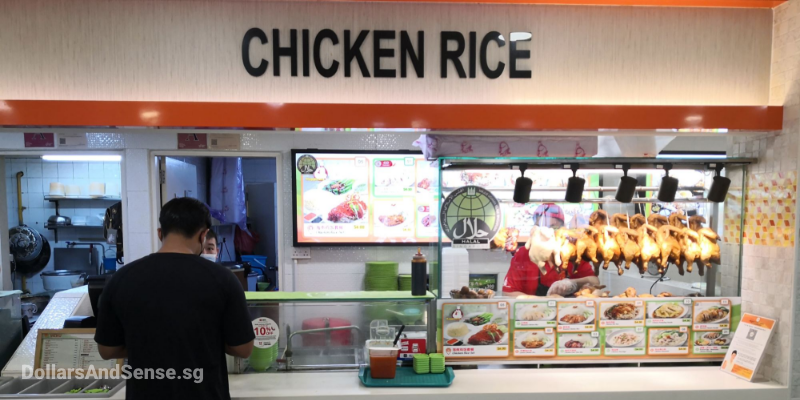
Even when a certificate is displayed, verification gaps can compromise halal integrity:
- Expired certificate still on the wall — Validity dates must span today’s date; an expired cert is invalid
- Wrong outlet name or address — Certificate lists “ABC Catering Pte Ltd” but signboard reads “ABC Bistro,” or unit numbers don’t match
- Photocopied or faded certificate — MUIS requires the valid original displayed prominently; photocopies are not acceptable
- “Muslim-owned” without MUIS certificate — The business is operated by Muslims but has no external audit of suppliers or cross-contamination controls
- “No Pork No Lard” label ≠ halal-certified — Absence of pork does not verify halal slaughter of chicken, alcohol-free sauces, or segregated utensils
- Vegetarian ≠ halal — Alcohol-based cooking wine, gelatin, or E-number emulsifiers from non-halal sources may still be present
- Delivery app filters are self-declared — Apps do not verify MUIS status; always cross-check the outlet on the MUIS directory
- Hidden animal-derived additives in packaged food — Gelatin (desserts, marshmallows), E471/E472 emulsifiers (bread, biscuits), rennet (cheese), L-cysteine (dough conditioner) may be pork- or non-halal cattle-derived
Everyday Occasions
When halal verification matters most:
- Office Hari Raya or Deepavali catering — HR and admin planning for 50–500 pax; the caterer’s MUIS cert must cover the central kitchen and each service outlet
- School canteen tenders and corporate pantry contracts — Institutional buyers require MUIS certification for compliance and assurance to Muslim staff and students
- Wedding receptions, Aqiqah celebrations — Family events at void decks or community centers; the caterer’s certificate must match the registered business name on the invoice
- Hawker stall lunch runs — Before becoming a regular, check the physical cert at the stall (often displayed beside the cashier or above the food display)
- Food delivery apps — Cross-check the listed outlet on halal.muis.gov.sg; app halal tags are self-declared, not verified by MUIS
Popular dishes often checked: Nasi lemak (halal chicken rice?), char kway teow (lard-free?), roti prata (ghee source?), rendang (spice paste additives?), mee goreng, satay (marinade ingredients?), Western fast food (fries cooked in shared oil?). The certificate removes the guesswork.
How to Choose / What to Look For
The six-point consumer checklist before booking a caterer or choosing a stall:
- Ask for the MUIS halal certificate number and company name; search halal.muis.gov.sg by name or certificate number
- Check the directory match — Registered name, outlet address, scheme type (e.g., “Eating Establishment Cat 1” or “Food Preparation Area”)
- Verify validity dates on the physical certificate (if viewing on-site) or in the directory listing
- Confirm the certificate covers the service location — For catering, check that the central kitchen and any satellite prep or packing facility are certified
- Ask two questions:
- “Where do you source your meat and chicken?” (Answer should name a MUIS-certified or MUIS-FHCB supplier)
- “Are your delivery vehicles and equipment halal-only or shared?” (Dedicated halal-only transport is safer)
- Look for red flags — Alcohol served on-premises, “halal-friendly” label with no displayed certificate, or staff cannot produce a certificate on request
For imported packaged products (grocery shopping, event snacks):
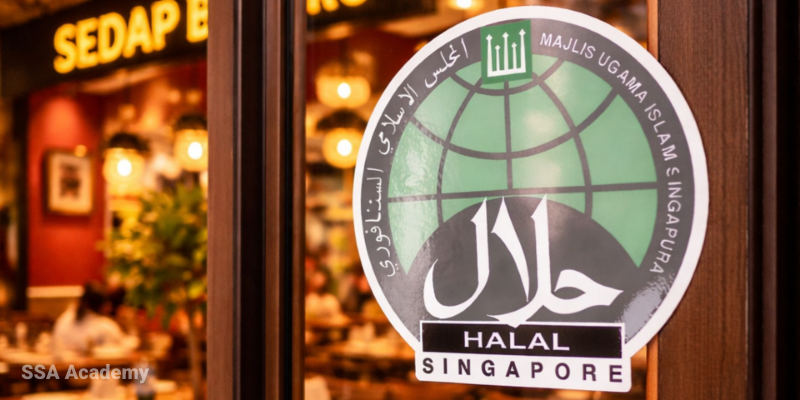
- Check for MUIS logo on the pack (green crescent-and-star mark, “MUIS Halal” text)
- OR check for a MUIS-recognized FHCB logo (searchable on halal.muis.gov.sg/fhcb by country or body name)
- An unrecognized foreign certificate (e.g., a Thai or Philippine logo not on the MUIS list) has no verified halal status for Singapore
(Deep procurement—RFP vetting, audit trails, multi-site corporate contracts—is covered in our International Government Catering guide. This checklist is for everyday consumer and event-host decisions.)
Key Takeaways
- MUIS is the sole legal certifier under AMLA; fake halal claims carry a S$10,000 fine and 12 months imprisonment
- One certificate covers one outlet address; chain restaurants require separate certificates per branch
- Verify live status on halal.muis.gov.sg—Muslim-owned does not equal MUIS-certified
- Foreign certificates are valid only if the issuing body is MUIS-recognized; check the FHCB list before accepting imported products
- Ask caterers two questions: source suppliers and whether transport is halal-only
- From October 2025, scan QR codes on certificates for instant live verification

Where Intercontinental Catering Fits
Intercontinental Catering is a MUIS-certified halal caterer offering buffet and bento catering across Singapore, with delivery daily including public holidays. Our central kitchen holds MUIS Food Preparation Area certification (cert no. FPGX21070001570, MUIS-certified since 2000), covering halal buffet spreads, individually packed bento sets, and event catering for corporate functions, school events, and family celebrations.
What we offer:
- MUIS-certified halal buffet catering — Malay, Western, and fusion menus tailored to office Hari Raya functions, Aqiqah gatherings, and void-deck celebrations
- Halal bento boxes — Individually packed, delivery-ready sets for meetings, school events, and conference lunches
- Event catering expertise — Dedicated halal-only kitchen and transport to eliminate cross-contamination risk
- Delivery across Singapore — Same-day and next-day delivery available, including public holidays
- Compliance documentation — MUIS certificate copies and source verification provided for corporate audit trails
How to engage: Request a quote via our website or call our catering hotline. For large corporate or institutional orders, we provide MUIS certificate documentation and supplier verification for compliance requirements.
Disclosure: Intercontinental Catering is a MUIS-certified halal caterer (cert no. FPGX21070001570). Verify current certification status on the MUIS halal directory before booking.