
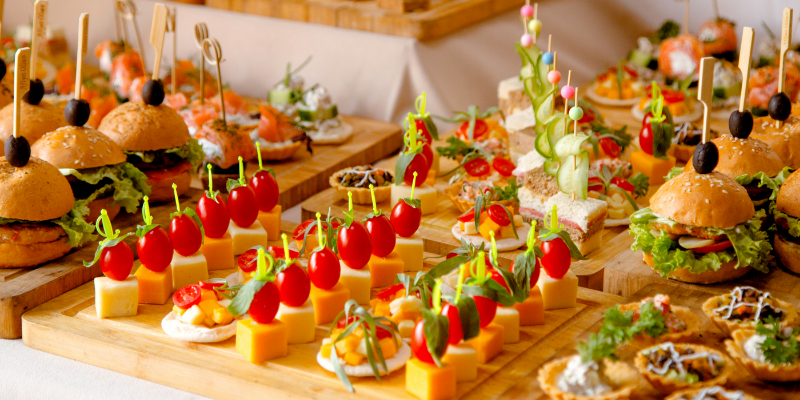
 You’re staring at two quotes — sealed bento at $15/head, buffet at $22/head — and the buffet looks pricier. It isn’t that simple: the buffet quote hides transport, crew, and minimum-order fees that can flip a “cheaper” number into 134% more.
The choice between bento boxes and buffet catering isn’t about which costs less in the abstract — it’s about which format the math, logistics, and hygiene requirements of your specific event actually favour.
Quick Facts: Bento vs Buffet at a Glance
|
Decision Axis |
Bento Box Catering |
Buffet Catering
|
|---|---|---|
|
Deployment Model |
Drop-off in 30-min window; zero setup or crew |
Full buffet: crew setup with warmers + tables; mini-buffet: disposable trays, no crew |
|
Pricing Structure |
Flat per-box rate; minimums 10–20 pax |
Tiered per-head + bundled equipment/staff fees; minimums 20–40 pax |
|
Setup Logistics |
No venue space, equipment, or staff required |
Full buffet: 15 ft × 3 ft table space, power for warmers; mini-buffet: counter space only |
|
Halal Handling |
Per-box MUIS isolation; zero shared utensils |
Dedicated serving lines, colour-coded utensils, on-site labelling to prevent cross-contact |
|
SFA 4-Hour Compliance |
Sealed portions simplify enforcement; each box timestamped |
Open chafing lines sit in danger zone; requires active temperature monitoring |
|
Lead Time |
3 working days standard; 1–2 days urgent via WhatsApp when capacity permits |
Mini-buffet 3–5 days; full buffet 1–2 weeks; festive peaks 4–6 weeks |
|
Key Strength |
Portion control, hygiene isolation, zero-waste headcount accuracy |
Social atmosphere, variety display, economies of scale at 100+ pax |
|
Key Weakness |
No communal experience; fixed per-box cost less flexible at scale |
Portion variability, food waste, venue-space demand, hygiene burden with shared utensils |
|
Best-Fit User |
Seated time-pressured events, strict dietary/halal separation, small-to-mid headcount |
Social celebrations, large-scale events where per-head cost drops below bento crossover |
Pricing effective 2026-07-12; verify current rates with your chosen caterer.
What Event Catering Actually Means in Singapore
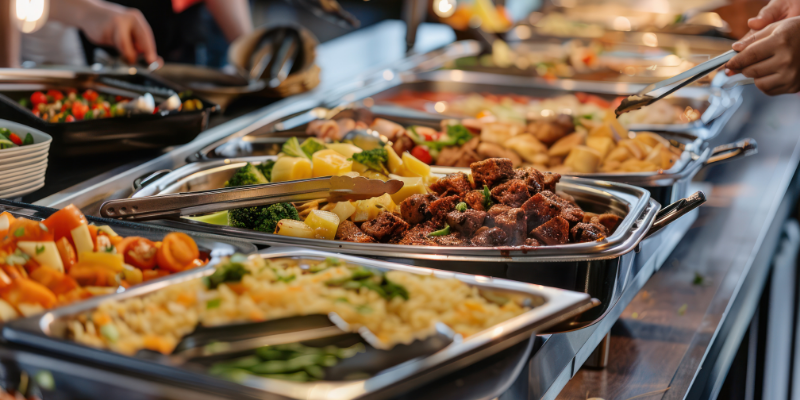
Event catering in Singapore spans professional meal preparation and delivery for corporate gatherings, community events, and private celebrations ranging from 10 to 300+ attendees. The category encompasses two dominant formats: sealed individual bento boxes (portion-controlled, drop-off) and shared buffet spreads (multi-dish, with setup equipment ranging from disposable mini-buffet trays to full chafing-line service). Both operate under Singapore Food Agency temperature-control mandates — the 4-hour rule limiting prep-to-consumption windows and the 5°C–60°C danger zone where bacterial growth accelerates — and MUIS halal certification when required.
Post-COVID market dynamics reshaped buyer preferences: Singapore caterers saw a 13.7% sales surge in March 2026 driven by individual-portion demand, elevating bento boxes from Japanese-niche specialty to mainstream corporate default for hygiene-conscious planners. Buffet catering responded with sustainability pivots (biodegradable disposables, smaller chafing pans to reduce visual waste) and wellness menus (plant-based dishes, low-carb options) to reclaim territory in social and celebratory events where communal atmosphere justifies the operational complexity.
This comparison serves office managers, HR coordinators, event planners, and family hosts choosing between formats for seated training sessions, social dinners-and-dances, baby full-month celebrations, or corporate seminars — scenarios where MUIS-halal compliance and SFA food-safety adherence are baseline requirements, not differentiators.
Feature-by-Feature: When Each Format Wins
Event Format & Social Dynamics
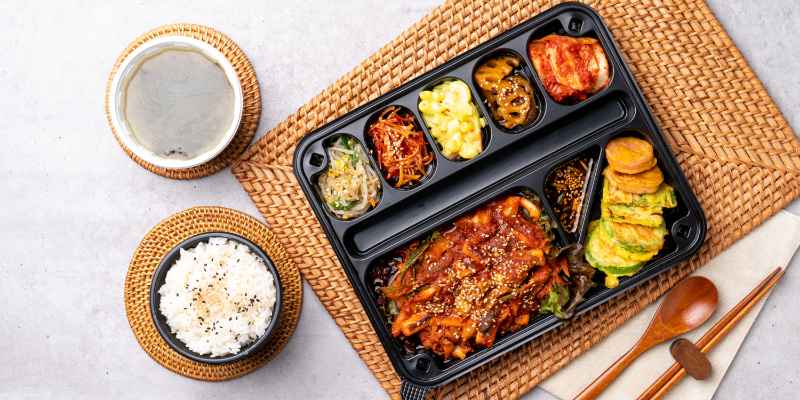
Bento boxes solve time-pressure and seated-format constraints: each guest receives a sealed meal the moment they sit, eliminating queue delays and ensuring a training seminar or AGM stays on schedule. The sealed individual format removes shared-utensil contact, appealing to hygiene-conscious corporate buyers post-2020. Wedding receptions and Hari Raya celebrations occupy the opposite end — buffet spreads create mingling opportunities around food stations, and the visual abundance of 8–12 dishes signals generosity in a way individually boxed meals cannot replicate. The trade-off is operational: buffet queues form at 100+ headcount unless you deploy multiple serving lines, while bento distribution scales linearly (one person hands out 200 boxes as easily as 20).
Headcount Economics & the Cost Crossover Point
The conventional wisdom that “buffet is always cheaper” collapses under small-scale math. Bento pricing is transparent: multiply per-box cost by exact headcount. Buffet pricing bundles food, equipment rental (warmers, chafing dishes, skirted tables), transport fees, and crew wages — costs that amortize favourably at scale but penalize small events.
Worked Example: 25-Person Office Lunch, Standard Tier (as of 2026-07-12)
|
Cost Line |
Bento Box ($15/box) |
Buffet ($22/head, 40-pax min)
|
|---|---|---|
|
Food |
25 × $15 = $375 |
40 × $22 = $880 (charged for minimum) |
|
Transport |
Included or $30 flat |
$80 standard |
|
Equipment & Setup |
$0 (drop-off only) |
Included in per-head rate |
|
Service Staff (3 hr) |
$0 |
$150 crew surcharge |
|
Wastage Buffer |
$0 (exact headcount) |
10% × $880 = $88 |
|
Total |
$375–405 |
$1,198 |
|
Per-Pax (actual 25) |
$15.00–16.20 |
$47.92 |
|
Winner |
Bento by 66% margin |
— |
The crossover occurs where buffet’s lower per-head food cost offsets fixed fees. At 100 attendees, buffet per-head drops to $28–32 all-in (food $22 + $80 transport + $150 staff ÷ 100 = $24.30, plus wastage), undercutting mid-tier bento’s $15–18/box when negotiated bulk rates aren’t available. Premium executive bento ($30–80/box) never crosses over — its use case is individual presentation and dietary labelling for client-facing VIP meals, not cost efficiency.
SFA Food-Safety Compliance: The 4-Hour Rule & Temperature Control
Singapore Food Agency mandates ready-to-eat food must not remain in the 5°C–60°C temperature danger zone for more than 4 hours from kitchen prep to guest consumption, as bacterial multiplication accelerates to unsafe levels within this window. Both formats face the same rule, but enforcement difficulty diverges sharply.
Bento’s sealed individual portions make compliance mechanical: each box carries a prep timestamp, remains sealed until the guest opens it, and the caterer’s 4-hour liability window is cleanly bounded by drop-off time plus event duration. The sealed environment prevents external contamination and eliminates shared-utensil cross-contact, giving corporate buyers confidence that no guest will inadvertently expose another’s meal to allergens or non-halal items.
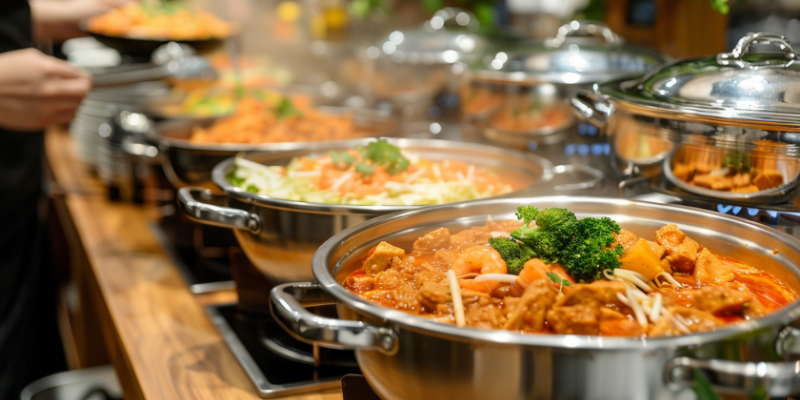
Buffet catering operates in the danger zone by design: chafing dishes and fuel warmers hold food above 60°C but don’t eliminate the clock — prep, transport, setup, and guest-serving windows all consume the 4-hour budget, leaving caterers little margin if traffic delays setup or guests arrive late. Open serving lines expose food to room air, and shared serving spoons cycled between dishes introduce cross-contact risk unless staff actively monitor and replace utensils. Temperature compliance becomes an operational burden — caterers must track timelines tightly and communicate consumption deadlines to event hosts, whereas bento’s sealed format makes the deadline self-evident per box.

MUIS Halal Handling & Dietary Accountability
Both formats require MUIS halal certification from the Islamic Religious Council of Singapore when serving Muslim guests, but the operational paths differ. (Serving vegetarian, vegan, or gluten-free guests under halal? See our dietary-specific halal catering guide.) Bento achieves per-box isolation: each sealed box is independently halal-certified during kitchen prep, eliminating any risk of cross-contact with non-halal items during transport or distribution. Guests identifying halal boxes is trivial — the label is printed directly on the sealed container, and no shared utensils exist to create perception issues.
Buffet caterers serving mixed-dietary groups must implement dedicated halal serving lines with colour-coded utensils, separate chafing pans, and clear on-site signage to prevent Muslim guests from inadvertently using a spoon that touched pork or non-halal protein. Equipment previously used for non-halal prep requires MUIS ritual cleansing before halal food contact. The compliance burden shifts from kitchen-only (bento) to kitchen-plus-event-site (buffet), requiring either dedicated halal-only buffet setups or rigorous staff oversight to prevent utensil mix-ups during multi-hour service windows.
Allergen labelling follows the same split: bento boxes carry printed content and allergen warnings per box, making identification foolproof at distribution. Buffet setups rely on table-tent cards or verbal staff communication, which fails when guests serve themselves from unlabelled backup trays or cards are moved by earlier guests.
Setup Logistics & Venue Requirements
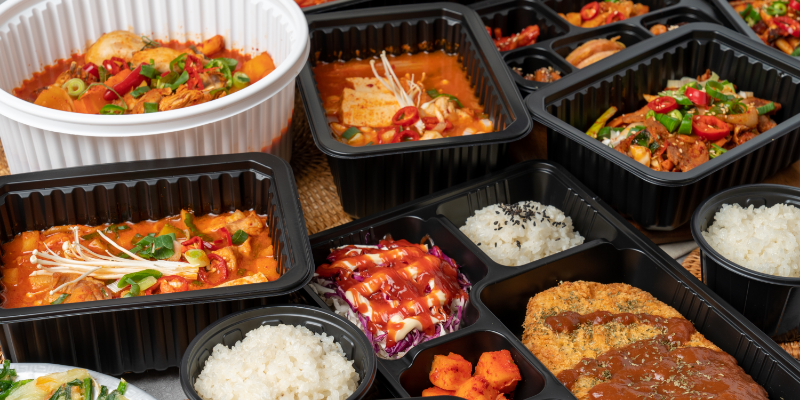
Bento delivery is zero-footprint: the caterer drops boxes in a 30-minute window at your specified location, requires no equipment, no staff presence beyond the driver, and no venue coordination beyond “put the boxes here.” The format works in venues with no kitchen access, no power outlets, and no event-setup infrastructure — conference rooms, outdoor pavilions, training centres with theater-style seating all handle bento identically.
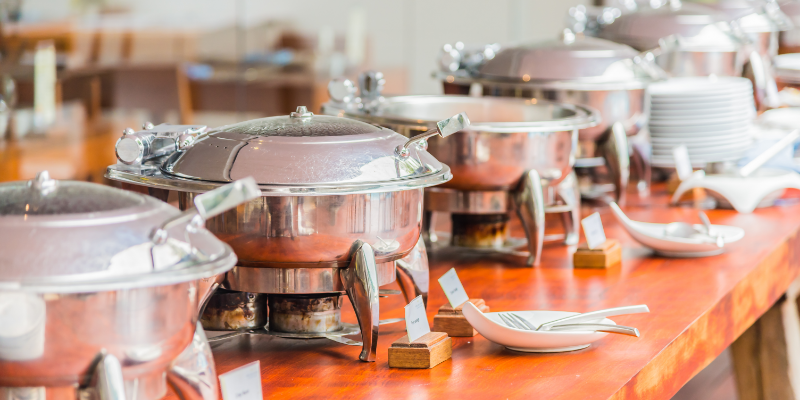
Full buffet catering demands venue space: approximately 15 feet × 3 feet for a skirted buffet line serving 50–100 guests, power access for chafing-dish warmers, and clearance for a crew to arrive 60–90 minutes before guests for setup. The setup window consumes event timeline — if your seminar runs 12:00–13:00 and you book buffet, the crew needs venue access by 10:30 to complete setup and depart before guests arrive at 11:45. Venues without loading-dock access, or with restricted lift capacity, incur surcharges for stair-carry or hand-trolley logistics.
Mini-buffet format (disposable trays, no crew setup) occupies the middle ground: requires counter space equivalent to 3–5 trays but no power, no staff, and no advance setup window. The caterer drops the trays; your team opens lids and serves.
Lead Time & Ordering Flexibility
Bento caterers quote 3 working days as standard lead time, with urgent 1–2 day turnaround available via WhatsApp when kitchen capacity permits (most common for budget-tier orders under 50 boxes). Orders exceeding 100 boxes extend to 5–7 days to accommodate bulk prep. Same-day delivery exists as an exception, not a service tier — call-ahead and expect limited menu selection.
Buffet lead times scale with format: mini-buffet drop-offs need 3–5 days; full buffet with crew setup requires 1–2 weeks for weekday events, longer for weekend bookings that fill faster. Festive periods (Chinese New Year, Hari Raya, Christmas, National Day) extend all lead times to 4–6 weeks, with December corporate parties booking 21–30 days ahead to secure preferred dates. Cancellation penalties apply universally: 3+ working days before event = no charge or 50% retention; under 1 working day = 50%; same-day cancellation = 100% charge plus $100 admin fee.
Headcount flexibility favours bento: adjust your order up to 2 days before delivery with minimal friction. Buffet adjustments require re-quoting equipment and staffing, making last-minute increases costly and decreases subject to minimum-pax penalties if you drop below the contracted threshold (typically 20–40 pax depending on package tier).
Portion Control, Waste, & Presentation Perception
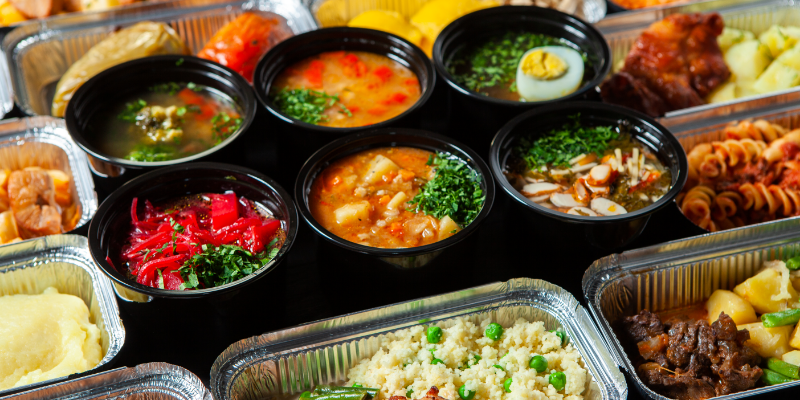
Bento delivers zero-waste headcount accuracy: order 47 boxes, receive 47 meals, serve 47 guests. No buffet-style over-serving, no half-empty trays at event end, no “we ordered for 50 but only 38 showed up” waste scenarios. This precision appeals to budget-conscious corporate buyers and sustainability-focused event planners tracking food-waste KPIs.
Buffet catering accepts 10–15% wastage as structural: guests serve themselves unevenly (popular dishes deplete early, less-favoured items remain untouched), some take larger portions than they consume, and caterers over-provision to avoid the optics of empty trays mid-event. The visual abundance that makes buffets feel generous at weddings becomes a liability at cost-conscious corporate events where uneaten curry and rice trays return to the caterer for disposal. Smaller chafing pans refreshed frequently mitigate the problem but add labour cost.
The perception trade-off is real: a well-executed buffet spread with 8–12 dishes, live carving stations, and decorative presentation signals celebration and generosity in ways a stack of uniform bento boxes cannot. For client-facing gala dinners or milestone anniversaries, the communal buffet experience justifies the waste premium. For weekly team lunches or training sessions where food is fuel, bento’s clinical efficiency wins.
Pricing: Market Bands & Hidden Costs (as of 2026-07-12)
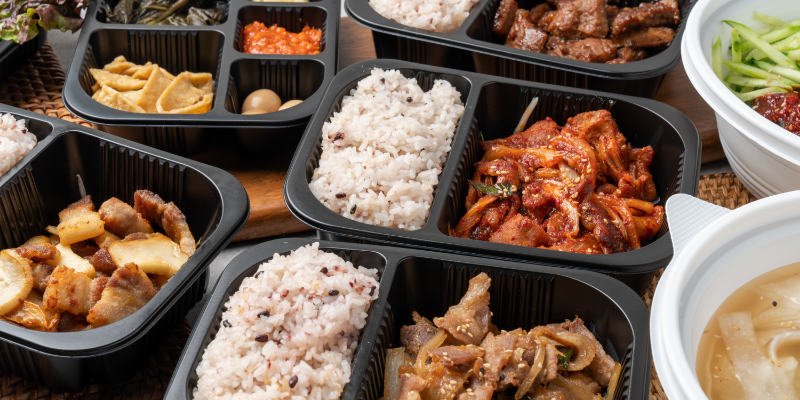
Bento Box Catering (per pax):
- Budget tier: $10–18 per box — includes protein (chicken, fish), 2–3 sides, rice, small dessert; minimum orders typically 10–20 boxes
- Mid-tier: $18–25 per box — upgraded proteins (premium chicken cuts, salmon), 3–4 sides, eco-friendly packaging
- Premium/Executive tier: $30–80+ per box — wagyu beef, unagi, high-presentation packaging for client-facing VIP events; minimums 10–15 boxes with advance notice
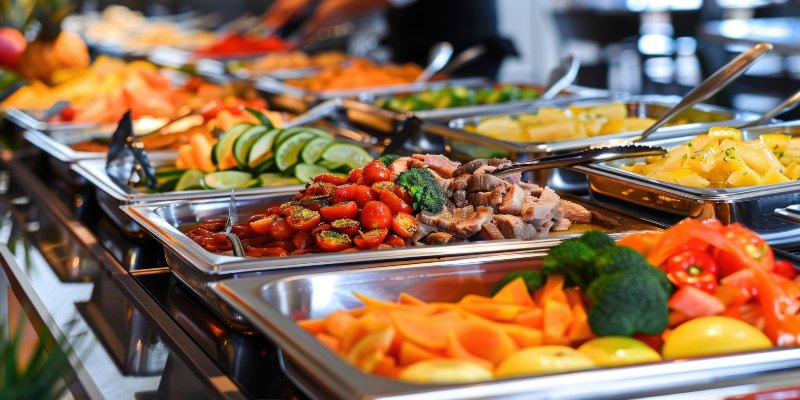
Buffet Catering (per pax, inclusive of equipment):
- Budget/Mini-buffet tier: $10–18 per head — disposable trays, 4–6 dishes, drop-off only, no crew; minimum 10–20 pax
- Standard/Full-buffet tier: $18–32 per head — 6–10 dishes, chafing setup, warmers, service crew, teardown; minimum 25–40 pax
- Premium/Live-station tier: $32–60+ per head — 10–12 dishes, live cooking stations (teppanyaki, carving, laksa bar), themed décor, extended service; minimum 50–100 pax
Hidden Costs (both formats):
- Transport fees: Bento $30 flat (often waived >50 pax or $200 order total); buffet $50 mini-buffet, $80 full buffet standard
- Service staff surcharges: Full buffet only — $150 per 3-hour crew shift ($50/hour overtime); chef on-site $200 per 3-hour shift
- GST: 9% on all catering invoices
- Festive-period premiums: Chinese New Year, Hari Raya, Christmas bookings incur 10–20% surcharges for staff wages and ingredient-supply disruption
- Venue-access surcharges: CBD locations with restricted parking, upper floors without lift access, or Sentosa events add $50–100
- Wastage buffer (buffet only): Caterers provision 10–15% above confirmed headcount to prevent mid-event depletion; you pay for the buffer
- Minimum-pax penalties: If actual attendance drops below contracted minimum, you’re billed for the minimum (e.g., book for 40, only 28 attend, pay for 40)
- Cancellation penalties: Under 3 working days = 50–100% charge; same-day cancellation forfeits full payment plus $100 admin fee
Most vendor pricing pages lack effective-date stamps — confirm quote freshness when comparing, as ingredient costs (especially seafood, premium beef) fluctuate quarterly.
Use-Case Winners: Match Your Event to the Right Format
|
Scenario |
Winner |
Why (≤12 words)
|
|---|---|---|
|
Corporate seminar / training, 10–100 pax, seated, 2–4 hr |
Bento |
Sealed portions enforce SFA 4-hr rule; zero setup delays |
|
Wedding / Hari Raya, 50–200+ pax, social mingling, 3–5 hr |
Buffet |
Celebratory atmosphere; cost-per-head drops at scale (see cost table) |
|
Small office lunch, 10–30 pax, 1 hr eating window |
Bento |
Precise headcount; fast drop-off; per-box halal isolation eliminates cross-contact |
|
Corporate D&D / team-building, 100–300 pax, 4+ hr social |
Buffet |
Economies of scale favour buffet beyond 80–100 pax crossover |
|
School / community iftar, 50–500 pax, fast mass distribution |
Bento |
Mass distribution simplicity; halal per-box labelling; no shared utensils |
|
Time-sensitive event (venue access <1 hr before start) |
Bento |
Drop-off requires zero advance setup; buffet needs 60–90 min crew window |
|
Strict food-safety / long-exposure event (4+ hr duration) |
Bento |
Sealed boxes easier to timestamp and enforce SFA compliance |
|
Client-facing executive lunch, <20 pax, premium presentation |
Bento (executive tier) |
Individual presentation per guest; dietary labels; no queue delays |
|
Mixed dietary + strict halal / non-halal segregation |
Bento |
Per-box MUIS isolation prevents utensil cross-contact perception issues |
Hybrid scenarios exist: large corporate events (200+ pax) sometimes deploy buffet for the main crowd and bento boxes for latecomers, VIP rooms, or guests with specific dietary restrictions requiring guaranteed separation.
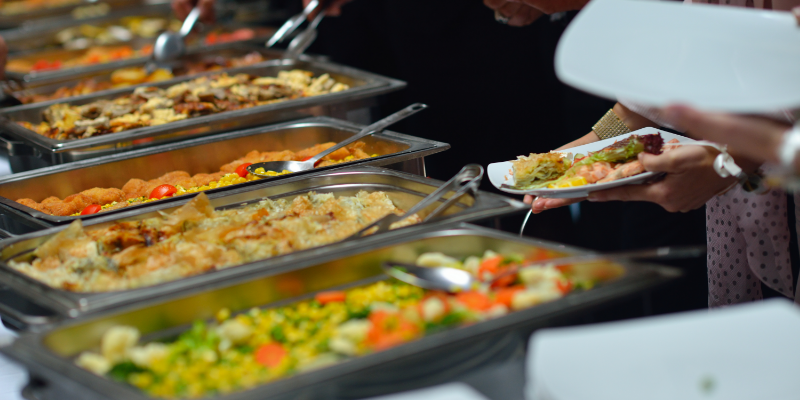
Switching Between Formats: When & How
Moving from Buffet to Bento (Recurring Corporate Lunches)
Office managers habituated to monthly buffet bookings switch to bento when headcount stabilizes below 40 attendees or when hygiene accountability becomes a priority post-audit. The procurement shift simplifies logistics: lead time shortens from 1–2 weeks to 3 days, no venue-space coordination, and per-order admin reduces to a single email or WhatsApp message with headcount and delivery time.
Cost impact: recalculate using the worked-example table in the Headcount Economics section at your typical attendance. If your monthly lunch runs 25–35 attendees, bento likely undercuts buffet’s bundled minimums by 40–60%. If your team routinely hits 60+, buffet retains cost advantage unless hygiene isolation or dietary-labelling precision justifies the premium.
Expectation-setting: communicate to staff that bento format eliminates variety display and communal serving — no “try a bit of everything” behaviour. Compensate by rotating menu themes (Japanese one month, Korean the next, local hawker-inspired bentos third month) to maintain novelty.
Scaling from Bento to Buffet (Growing Team Events)
Teams scaling past 80–100 attendees hit the crossover where buffet’s per-head economics outperform bento, assuming you have venue space and tolerance for the setup/teardown logistics. The format switch introduces vendor-selection criteria beyond price: verify MUIS halal certification if required, confirm crew punctuality track record (late setup disrupts event timelines), and request setup diagrams to ensure your venue space accommodates the buffet line footprint (15 ft × 3 ft minimum for 50–100 pax service).
Trial-run best practice: book the new buffet caterer for one mid-scale event (50–80 pax) before committing to annual contracts or large-format bookings. Evaluate food quality at volume, crew professionalism, and actual wastage rates against quoted provisioning.
No contract lock-in exists in Singapore’s per-event catering market — both bento and buffet bookings operate order-by-order with deposits (typically 30–50% upfront, balance on delivery). Cancellation penalties enforce commitment but don’t bind you to a single vendor across multiple events.
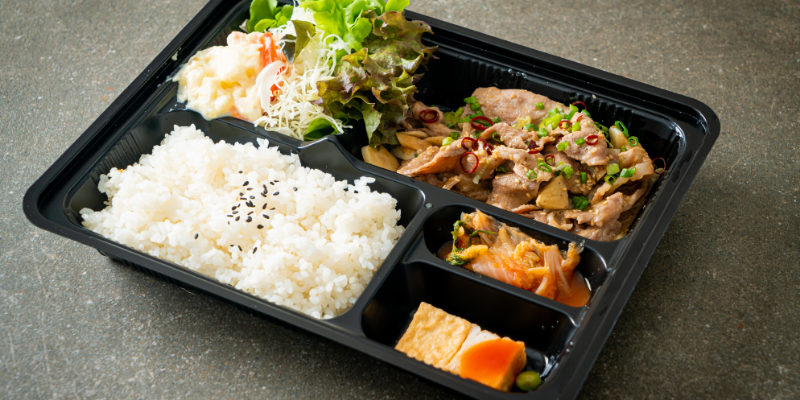
Verdict: No Universal Winner — Match Format to Event Reality
Bento boxes win seated time-pressured corporate events under 50 attendees where SFA 4-hour enforcement, halal per-box isolation, and zero-setup logistics justify flat per-box pricing. Buffet catering wins social celebrations above 80–100 attendees where communal atmosphere and economies of scale (amortized equipment, lower per-head food cost) outweigh the operational burden of venue space, crew coordination, and wastage provisioning.
The decision tree is mechanical: count your headcount, measure your venue space, check your timeline (can the caterer access venue 90 minutes early for buffet setup?), and run the cost math from the worked-example table. If your event demands halal/non-halal strict separation or individual dietary labelling, bento’s per-box isolation eliminates ambiguity that buffet’s shared-line protocols struggle to guarantee. If your guests expect variety display and mingling-over-food social value, buffet’s 8–12 dish spread delivers what a stack of uniform boxes cannot.
Hybrid deployments are valid: deploy buffet for the main 150-person crowd, bento boxes for the 20 latecomers or VIP room requiring guaranteed halal separation. The formats complement rather than compete when your event segments naturally split by timing, location, or dietary constraint.
No format is “better” — both are tools optimized for different jobs. Choose the one your specific event’s math, logistics, and hygiene requirements actually favor.