
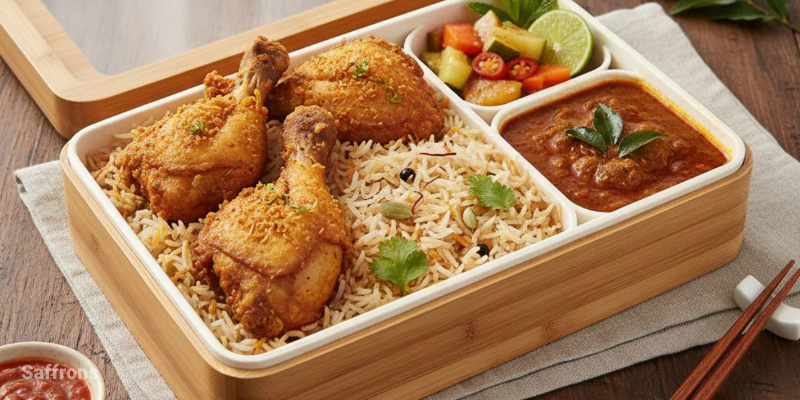
 Corporate buyers ordering halal bento catering for office lunches or company events face one consequential mistake: assuming “halal-style” menus equal MUIS certification. When observant Muslim colleagues or clients attend, self-declared halal disqualifies the entire order. This shortlist verifies three MUIS-certified caterers that ship individually-boxed halal meals islandwide, with transparent per-pax pricing and documented minimums.
Disclosure: This shortlist is published by Intercontinental Catering, which is one of the caterers listed. Where Intercontinental Catering is the right fit it says so plainly; where another caterer fits a use-case better, it says that too.
Quick Picks
- Best overall value for SME recurring office lunches: Intercontinental Catering — entry-tier bento from $9/pax, 20-pax minimum for mini buffet, Western-fusion halal specialization.
- Best for multinational corporate client lunches requiring ISO certification: Orange Clove — ISO 22000 food safety across Neo Group brands, fusion sando menus, biodegradable serviceware.
- Best for large-scale urgent orders (same-day/high volume): Neo Garden Catering — 3-hour express service for up to 500 pax, 34-year track record, Singapore Book of Records emergency-volume capability.
- Best for premium executive meetings with presentation-tier setup: Orange Clove — Executive bento tier $30/pax, real-flower centerpieces, HubSpot-CRM client management for recurring accounts.
What to Look For
- MUIS halal certification — verify the caterer on the official MUIS directory (halal.muis.gov.sg) before committing; the step-by-step is in our halal certificate verification guide, and what certification actually covers is in our halal standards guide. Self-declared halal is not equivalent.
- MOQ matching your event size — minimums range from 10 to 40 pax; a 15-person team lunch needs a 10-15 pax caterer, not a 30-pax floor.
- Per-pax price band + GST transparency — quote all-in cost (food + delivery + GST) in writing; delivery surcharges for CBD/offshore/no-lift access add $10-150.
- Delivery radius + lead time — confirm your postal code is covered; standard advance notice is 3-7 days, express services exist for 3-hour turnaround.
- Dietary-specific options beyond halal — vegetarian, vegan, allergen-free menus require separate prep; confirm cross-contact protocols if strict dietary observance matters.
- Track record + volume capacity — years operating, review scores, and peak-volume capability (100 vs 500 pax same-day) signal reliability for recurring or large-scale events.
- Food safety + logistics certifications — ISO 22000, AVA Grade A, or documented hygiene protocols beyond MUIS halal reduce risk for multinational compliance requirements.
At-a-Glance Shortlist
Provider | Halal cert | Price band | MOQ | Best for
|
|---|---|---|---|---|
Intercontinental Catering | MUIS FPGX21070001570 | Bento $9-10, mini buffet $19+ | 20-40 pax | Budget SME recurring lunch |
Orange Clove | MUIS FPGX22020001653 | Bento $13-30, buffet $21+ | 10-30 pax | Multinational ISO compliance |
Neo Garden Catering | MUIS-certified | Buffet $15.99+, bento $8-15 | 25-30 pax | Urgent large-volume orders |
Price bands effective 2026-07-12, exclude GST unless stated. Verify current rates and availability directly with each caterer.
How We Chose
This shortlist applies five criteria: verified MUIS halal certification (each caterer confirmed on halal.muis.gov.sg as of 2026-07-12), published bento/buffet offerings, documented MOQ and per-pax pricing, islandwide delivery, and own-site plus independent-source fact verification. Each caterer’s MUIS certification was verified on the official MUIS directory on 2026-07-12.
Intercontinental Catering
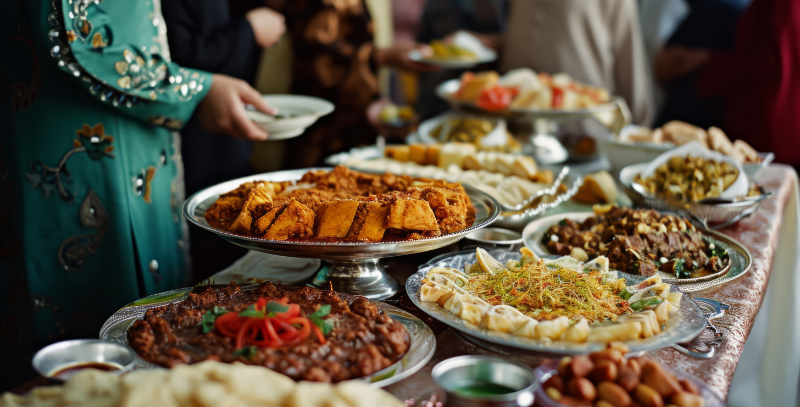
MUIS-certified bento and mini buffet caterer for corporate and community events 20-80+ pax, specializing in Western-fusion halal menus that serve offices and client lunches where Asian-only menus don’t fit.
Detail | Intercontinental Catering
|
|---|---|
Delivery | Islandwide; CBD/Orchard/Sentosa +$10, no Jurong Island; no-lift +$60/level |
Lead time | Standard advance notice; 7am-6pm delivery window |
Cuisine | Western-fusion halal (Baked Chicken with Mushroom, Hong Kong Noodle, Chicken Rice) |
Food safety | None disclosed beyond MUIS halal |
Track record | 6 years operating (incorporated 2018); FoodLine 3.0/5 (34 reviews), Google 4/5 (38 reviews); Sentosa government tender panel 2021 |
Differentiator: Western and fusion halal buffet specialization — live stations include Traditional Laksa, Signature Mee Siam, Assorted Maki Sushi, and Roti Prata with Curry, a local-Western-Japanese hybrid approach distinguishing it from pure Malay/Asian halal caterers.
Orange Clove
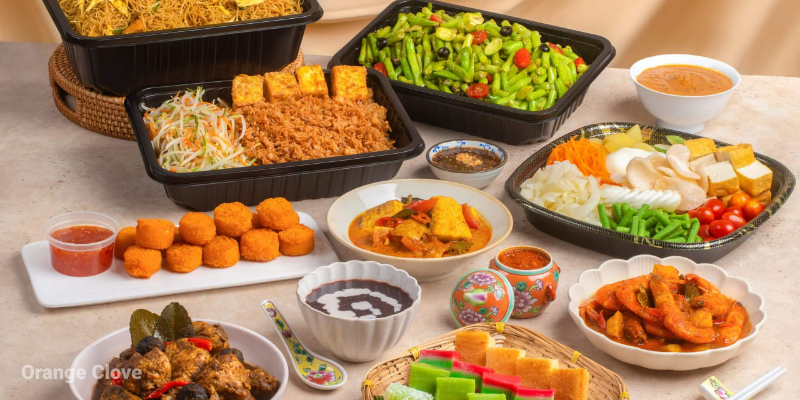
MUIS-certified fusion bento and buffet caterer for multinational corporates and government agencies requiring ISO 22000 food safety certification, operating under SGX-listed Neo Group Limited.
Detail | Orange Clove
|
|---|---|
Delivery | Islandwide; limited slots Air Cargo/offshore/CBD/no-lift; mini buffet exception ground-level drop-off |
Lead time | 3-7 days standard; 4-hour urgent notice reported (unverified on own site) |
Cuisine | Cross-cultural fusion Asian + International; gourmet sando menu (2024 launch) |
Food safety | ISO 22000 across Neo Group brands; in-house food safety officers since 2016 |
Track record | 17 years operating (founded 2008); Singapore’s No.1 Corporate Caterer (Euromonitor 2024); EXSA 2025; Straits Times Best Customer Service 2023/24, 2024/25 |
Differentiator: Sophie the Robotic Chef (world’s first robotic noodle station, 2019) and biodegradable serviceware sustainability campaign (bamboo/bagasse plates, FSC-certified serviettes, plant-based polylactic acid-coated cups) for clients prioritizing environmental compliance.
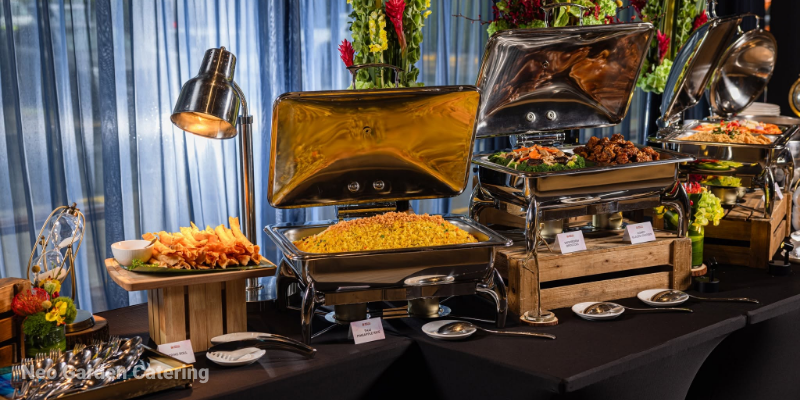
Neo Garden Catering
MUIS-certified caterer with 34-year track record and Singapore Book of Records emergency-volume capability, offering 3-hour express bento/buffet service for up to 500 pax.
Detail | Neo Garden Catering
|
|---|---|
Delivery | Islandwide + CBD/offshore surcharge; two central kitchens east/west for allocation efficiency |
Lead time | 48 hours recommended online; 3-hour express for up to 500 pax |
Cuisine | Asian + international buffet, weekly-refreshed bento menu, tingkat meal delivery 200+ dishes |
Food safety | ISO 22000:2005; AVA Grade A 2017/16, AVA Food Safety Excellence Gold 2015 |
Track record | 34 years operating (founded 1992); #1 events caterer Singapore (Euromonitor, retained since 2011); Singapore Book of Records 1,790 buffet orders single day (CNY 2017) |
Differentiator: Emergency 3-hour catering at scale — the only shortlisted caterer with documented 3-hour turnaround for up to 500 pax, enabled by semi-automated 76,000 sq ft headquarters and dual east-west central kitchens for rapid allocation.
Best Provider by Use-Case
Use-case | Best fit | Why (≤12 words)
|
|---|---|---|
Budget SME office lunch 20-50 pax | Intercontinental Catering | Entry $9 bento, 20-pax mini buffet minimum, value-tier pricing |
Multinational corporate client lunch requiring ISO | Orange Clove | ISO 22000 certification, fusion sando menus, Neo Group parent |
Large-scale urgent order (same-day/high volume) | Neo Garden Catering | 3-hour express for 500 pax, dual central kitchens |
Premium executive meeting 10-20 pax | Orange Clove | Executive bento $30/pax, real-flower setup, biodegradable ware sustainability |
Recurring school/community programme account | Neo Garden Catering | 34-year reliability, weekly-refreshed menus, 200+ tingkat dishes |
For recurring corporate accounts where account management and invoicing automation matter, Orange Clove’s HubSpot CRM platform streamlines order-to-follow-up; for one-off events where cost is the deciding factor, Intercontinental Catering’s $19 mini buffet with 20-pax minimum undercuts competitors by $1-6/pax.
How to Shortlist & Verify
- Confirm the caterer’s current MUIS halal certification on the official directory (halal.muis.gov.sg) — check the establishment name, address, certificate number, and expiry date.
- Get MOQ, delivery slot, total all-in cost (per-pax + delivery + GST + surcharges) in writing before committing.
- Request a tasting box or sample set for menu quality and portion sizing — reviewers report portion exactness varies (no buffer assumed).
- Verify vegetarian/vegan/allergen-free options use separate prep and utensils if strict dietary observance is required.
- Confirm cancellation deadlines and headcount-change windows in writing — policies range from 3-5 working days with 50-100% charges.
- Check delivery surcharges for your postal code — CBD/Orchard/offshore/no-lift access add $10-150; clarify “islandwide” excludes Jurong Island for some caterers.

Where Intercontinental Catering Fits
Intercontinental Catering is best for budget-conscious SMEs, recurring office lunches, and community events where 20-80+ guests need MUIS-certified Western-fusion halal bento or mini buffet at value-tier pricing.
What’s included:
- MUIS halal certification (FPGX21070001570, verified on halal.muis.gov.sg 2026-07-12)
- Bento from $9/pax (Deluxe tier, 40-pax minimum); mini buffet from $19/pax (20-pax minimum)
- Islandwide delivery (CBD/Orchard/Sentosa +$10 surcharge; Jurong Island unavailable)
- Western-fusion specialization (live laksa, mee siam, sushi, prata stations)
- Six-year operating track record; Sentosa government tender panel 2021
Request a quote at incntl.com.sg or call during office hours (Mon-Fri 9am-5pm, Sat 9am-12pm). This shortlist is published by Intercontinental Catering; where another caterer fits a use-case better, it says so plainly.